

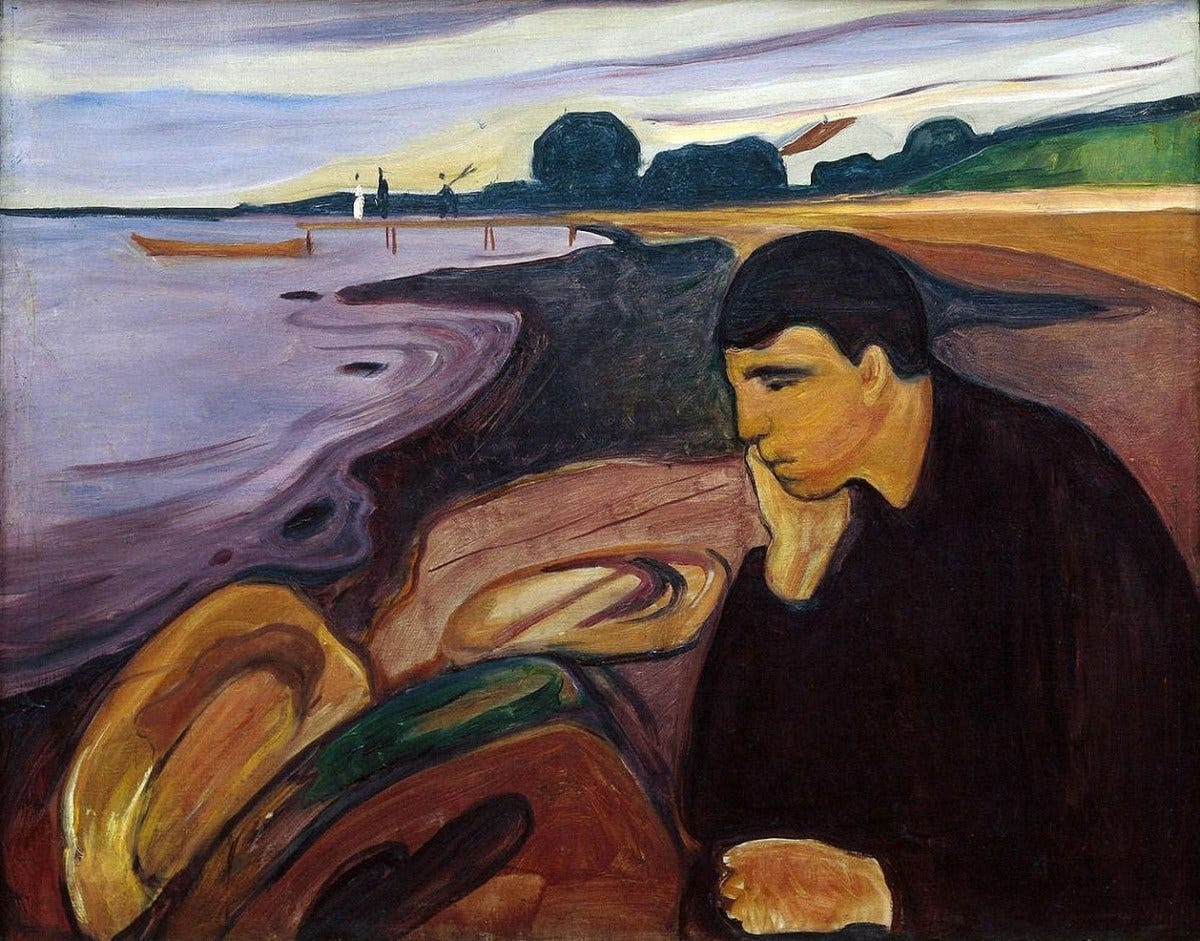
The ego is not a soul. It is an operating system (poorly maintained, running on loops of thought and shame and despair and old behavioral scripts) trying to convince you that you are a single, coherent thing. A person. Left running overnight, it generates the usual errors: chronic disconnection, the persistent itch that something is wrong, that endless searching for a cure that is always in the next room, with the next person, in the next version of yourself. The point isn’t to destroy it. The point is to name it precisely, to watch it stutter, and finally to understand exactly what we’re all running away from: the fact that we’re already here, in this body, with no exit.
That itch has a name and it is something older than sadness itself. It is band in the stomach, being slowly ripped apart: Existential loneliness. Feel it in thy bones. It arrives not when you’re alone in a room but when you’re surrounded and still feel it: the sense that your inner life is happening in a language no one else can translate, no one can even understand. You lose someone, or you almost connect with someone who refuses, and suddenly the grief isn’t about them. It’s about that bedrock. The suspicion that you are fundamentally enclosed within your own skull, that every connection you make is temporary, that even if you find belonging you’ll only live in fear of losing it again. So you start to believe the loneliness is your fault. Not the environment. Not the architecture of being a bounded creature. You. You weren’t good enough to belong. You are the malfunction. The virus. The ghost in the machine…
And so you seek to be seen. You build a theater like the clown that you are: vulnerability as costume, openness as pure strategy. You want someone to look at the true machinery of you and stay. You want to be desired for your unvarnished blueprint. And sometimes, sometimes (briefly) it works. There is a moment in a friendship or in a conversation that lasts until 3 a.m., where you think: this is it, after all these years. I have been found. But the years pass, or they don’t, and you realize you were never actually one thing with them. You were two simulations, pressing against each other through glass. They perceived you through their own framework; you perceived love through yours. What you called connection was a beautiful illusion: real, certainly, in the way dreams are real, but not proof against the fact that you always wake up inside the same skull.
Here is the heresy they don’t sell in self-help: there is nothing but superficiality in the material plane if you look outward. The eyes of the other person are surfaces. Their body is a surface. Even the deepest conversation is just two internal worlds bouncing signals off each other, hoping the echo sounds like unity. You think you’re reaching across some consciousness deep space, touching the other’s hidden core. But all perception happens inside your own simulation. The love you feel for them is a love happening within you. The connection you crave is a connection you’re already having… with yourself, disguised as them.
This should be terrifying. Instead, it’s a kind of mercy.
Because once you see it, once you understand that trying to escape your own mind is exactly what creates the feeling of being trapped, something loosens. You stop chasing, and stop fantasizing about the perfect group and the perfect partner and the perfect philosophy that will finally stitch your existence to theirs. The fantasy is the drug. The fantasy is the REAL addiction: if only I had that connection, I wouldn’t feel THIS. But you’ve had connections. You’ve had years of them. And the loneliness returned, because it was never about the other person. It was about the part of you that keeps isolating itself from your own existence.
So you turn inward. Not to fix yourself (fixing implies you are broken, and you’re not broken, you’re just misidentified) but to see. You take the bad parts, the future-oriented version of you, the regrets, the pride, the goals, the shame, and you stop judging them as separate crimes. You see the whole organism: not simply as a self to defend but a field of interconnection. Thousands of neurons, millions of molecules, sensations bouncing off each other, consuming and decaying, always in relation. There is no “you” there that is alone, except for the feeling that says you are. And that feeling is not a fact. It’s a pointer, exact, precise, showing you exactly where you’re still separating yourself from the whole.
This is not a cure. There is no cure. There is only the practice of not running. Of sitting with the ache without narrating it. Of noticing that you don’t need people the way the story says you do: you want them, naturally, the way a body wants warmth, but the need, the suffering, the rejection of your own situation: this can drop away. Not by isolation, but by mending the internal relationship. By feeling the emotions without editing them. By asking what your body and mind are actually yearning for, which is never another person’s approval but a deeper sense of self-love, the kind no external source can provide.
You will still want people. You will still form relationships. They will still break, or change, or fail to fill the hole you thought they would fill. That’s fine. That’s human. But the chronic seeking, the belief that your existence must be validated by another consciousness to be real, that can stop. You can want without needing. You can connect without clinging. You can be in a room of a hundred people, or alone with a burned piece of toast, and know that the boundary was never as solid as you were taught.
The cage was never locked. You were just too busy rehearsing your escape to notice you were already outside.