

[Hey guys: bad news and good news.
Bad: due to the continuing downturn of the Chinese economy (and subsequent knock on effect to International School enrollment) I recently lost my job as an English teacher - searching for a new one now.
Good: I’ve lowered the price to subscribe significantly (literally lowering it to as small a number as it would let me!) as I hope to build something more sustainable and open to more or all (hopefully). I will also have a more time to write! And also try to be more community oriented, rather than just scrabbling around and churning out writing in my previously pitiful amount of free time.
This piece now is in honour of my favourite writer de Quincey, most notably his English Stage Coach - there is an obvious intermixing of Dante, but a very modern and I might say more Hellish Dante. Enjoy.]
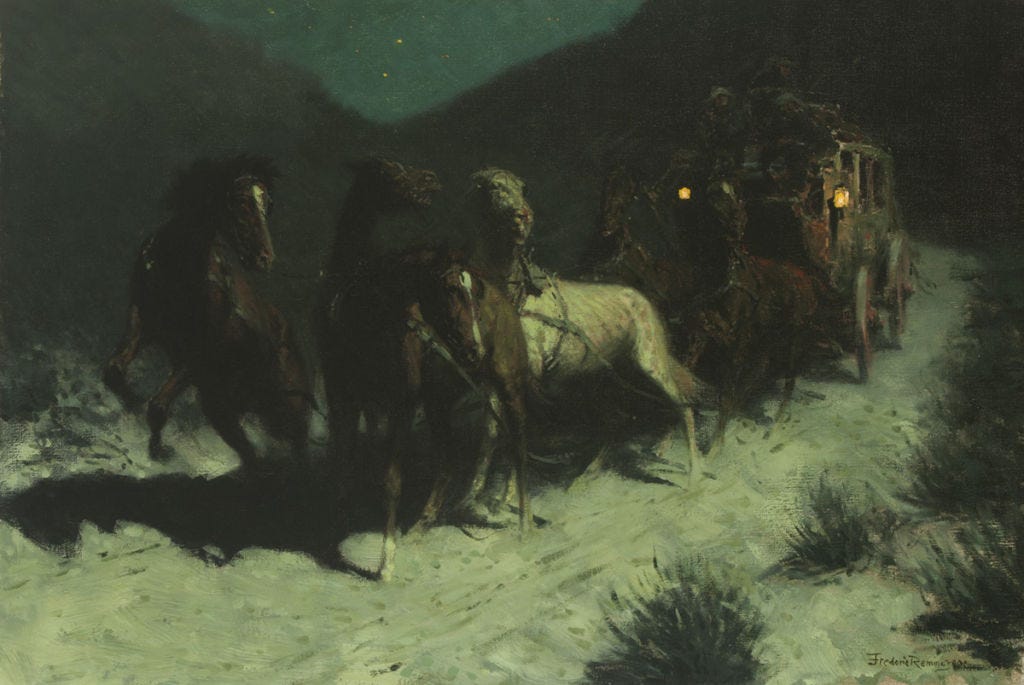
No one believes in hell anymore which is why everyone is always talking about burnout.
I know because I’m on the coach, circling that eternal conflagration we now call life.
It is not a metaphor. An actual coach. Or what looks like one. It arrived at half past two in the morning while I was standing in the kitchen with the kettle on, looking at a tea towel with a darkened patch where it had strayed too near the burner. Not ruined. Just marked. The way everything is marked now. My life. The kettle screamed. I turned. Through the window I saw it waiting in the street, black and somehow older than the street itself, older than the buildings, steaming in the orange lamplight like something that had been travelling a very long time through a very bad country.
The driver didn’t look at me. Just opened the door.
I got on because… well. What else was there?What eles to do? The inbox. The bill. The blue light. The slowly warming skull. I got on because I was already burning and had been for years and the coach at least was honest about it. You could see the flames painted on the sides. Small flames. Domestic flames. Nothing grand. Nothing operatic. Just the low continuous crackle of minor combustion rendered in chipped gilt and varnish.
Inside: empty. The seats worn to a shine. Smells of old leather and something underneath, something chemical and sweet like burnt plastic or hair. Formaldehyde.
The coach lurched forward before I’d sat down properly. I fell into a seat. The driver said nothing. We went on. We went down.
I am being quite literal now because the street tilted. The buildings leaned back. The orange lamps began to recede upward as though we were sinking, as though the road itself had become a ramp into the earth. I looked out the window. The city was still there but wrong. Taller. Darker. The windows of the buildings glowed not with electric light but with the light of screens, thousands of them, blue and white and cold and burning, and in each window a face bent toward the glow, mouth open, eyes wide, feeding.
First circle, I thought, though no one had said so. (Virgil, the ancient cicerone, now lies unread.) The circle of the mildly scorched. The people who’ve learned to live with it. Burnout as a managed condition. Optimise your depletion. Track your exhaustion. There’s an app for it. The light from their screens was very bright and very cold and as we descended past them I could see they were smiling. Not happiness. No. Just smiling. The smile you make when someone asks how you are and you say fine, you’re fine, everything’s fine, always fine, while something invisible chars a little more of your soul.
The coach went faster.
The Second circle came up quick. Suddenly we were in traffic. But this was not regular traffic. Every vehicle was the same. White vans. Thousands of them. All moving in the same direction. All driven by men in fleece quarter-zips, all whispering into wireless headsets, all saying the same thing: just circling back on this, just following up, just touching base, just-
The coach cut between them. They didn’t seem to notice. They never do. The vans went on circling, following up, touching base, going nowhere at incredible speeds, the drivers’ faces grey in the dashboard light, mouths moving, hands on the wheel, eyes on something that wasn’t the road, something further down, something they were driving toward without knowing it, the great flaming edifice of
No. Not yet. We weren’t there yet.
Third circle: the gym. Or not a gym. Many gyms. A whole district of them. Glass-fronted. Brightly lit. Inside, bodies on machines, running, cycling, climbing, rowing, going nowhere, burning nothing but themselves, carefully, precisely, turning fat into heat into data, the metrics glowing on screens, the bodies turning red, then redder, the faces twisted not in pain exactly but in something worse than pain, something that looked like faith. This is good for you. This is healthy. This is self-care. Thss is everything! The bodies burned and the machines counted and through the glass I could see the veins standing out on foreheads, the mouths open, gasping, the eyes fixed on the screens that told them how much they’d burned, how many calories, how many steps, how far they’d run while staying exactly where they were.
The coach didn’t slow and the gyms fell away and the street got narrower. Darker.
And the Fourth circle: it came like the
smell of a staff kitchen before I saw it. I knew it before we reached it because I could smell it. That smell. The smell of every bad job I’ve ever had. Fluorescent lights and carpet cleaner and dish soap and the faint persistent reek of microwaved fish and stale pizza. The buildings here were all offices. Every window showed the same scene. A meeting room. A long table. People sitting around it. One person standing, pointing at a screen, mouth moving. The others staring. No one listening. Everyone was waiting for it to be over. And it was never over. The meeting went on forever, the same meeting, in every building, every window, the same person standing and pointing and explaining something that didn’t need explaining to people who didn’t need to know, and the fluorescent lights overhead flickering, buzzing, giving off that particular frequency of despair that makes your teeth ache and your eyes go dry and your soul start to, very quietly, very politely, scream.
And we went faster still. The coach was old but it knew the way. The driver never turned. I wondered if there was a driver. I didn’t look. Sometimes it’s better not to look.
Fifth circle came as a relief at first. Domestic. Residential. Normal streets. Normal houses. Warm lights in windows. I could see people inside. Families. Kitchens. I wanted to get off. I wanted to knock on one of those doors and be let in and sit at one of those tables and be normal, be warm, be-
Then I saw what they were doing.
They were on their phones. All of them. Sitting at the table, together, alone, bent over the little screens, scrolling and scrolling and scrolling and scrolling, the food going cold in front of them, the child at the end of the table saying something, saying it again, saying it louder, and no one looking up, no one hearing, everyone scrolling scrolling through the endless feed of other people’s lives, other people’s dinners, other people’s children, everyone together and everyone alone and the phones glowing in their hands like little warm stones pulled from a fire, like something you’d cup your hands around in winter, like something that might keep you alive if you just held it close enough, tight enough, if you just didn’t let go
The coach took a corner hard. I was thrown against the window. When I looked up we were somewhere else entirely.
It was the Sixth circle. It was the hospital. Or the waiting room of the hospital. Or every waiting room of every hospital and every GP surgery and every A&E and every specialist and every dentist and every place you’ve ever sat under fluorescent lights filling in forms about your pain on a scale of one to ten while the person at reception doesn’t look up and the person next to you is coughing and the person across from you is bleeding quietly into a tissue and everyone is burning in their own private way and no one is helping because there’s no one left to help, because the help has been optimised, because the help has been cut, because the help has learned to manage its own burnout by developing a cheerful professional detachment that reads, from below, as cruelty, as, as, as, as
