

Take your time with this one - it’s a little dense - or you may regret it.
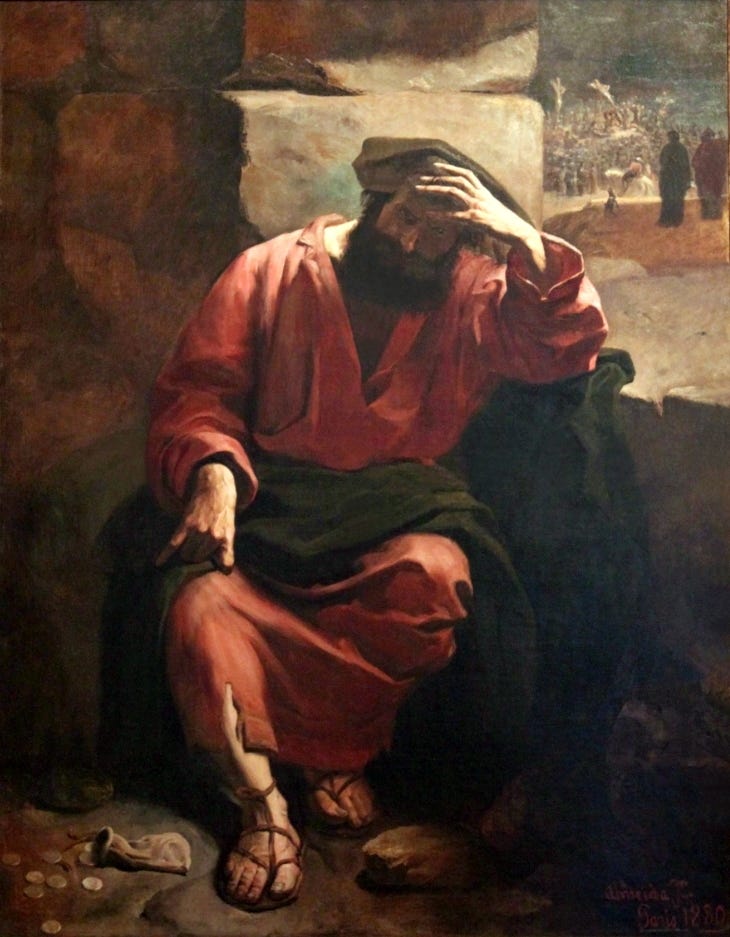
Regret is a bruise that never ripens. It flowers beneath the skin in gorgeous purples and sickly yellows, too deep for daylight-fingers, and whenever you prod the old flesh of memory you feel the ache pulse: a small private sunrise of pain. Most of us learn to live inside that bruise. It becomes our interior weather, the grain of every hour. You wake; you glance at your phone; you chew the smudged crust of last night’s dream; you grown sickly-pale; and the familiar iron taste is already there at the back of your throat: ah yes, regret, old friend, coil yourself around my ribcage, whisper that ordinary liturgy: should-have, could-have, would-have. It sits beside you on the bus. It edits your emails while you type. It crawls into bed while you sleep and kisses the lids of your eyes from the inside. It dreams your life for you. The miracle is that we are not screaming all the time. The miracle is that the city still stands, that the pavements are not flooded by the runoff of all our unhappened lives.
For myself, the first time regret pressed its cold snout against me I was eight, standing in a suburban garden after school, watching the neighbour’s koi float belly-up in its ridiculous ornamental pond. I hadn’t killed it, hadn’t even touched the water, but as the grown-ups fussed with nets and hoses, I felt the fish’s blank eye fix on my future; somehow its lazy suffocation would keep happening inside me for years. Regret does that. It wanders in from nowhere; it claims responsibility for events you never authored, then skulks around until every hour bears its muddy paw-print. Later you discover it has stolen your passport, forged your signature on the incident, and left you paying interest on its lie.
We are taught to imagine regret as some polite domestic ghost: something that drifts through memory, rattles the china, makes you sigh in cafés, then retreats when the waiter brings the bill. This is wrong. Regret is not retrospective. It is ravenous, hot-blooded, forward-feeding. Once it has marked you, you live in its projected aftermath, every decision already sagging with the weight of its coming autopsy. That is why you check your phone seven times before pressing send. Why you calculate escape routes from parties you have not yet entered. Why you dream of kissing someone new and wake up convinced you have already ruined it. Regret is a predatory animal that hunts by anticipation; by the time the calendar catches up, the kill is long finished.
But to speak of predators is only to approach the deeper thing sideways. For regret is older than any god we still dare name. Long before the first priest intoned a syllable, some ape on a drowned savannah must have paused over the bones of its child and felt the phantom tug of a gesture not made, some unreachable caress, and in that instant the world split into two: what is, and what will never now be. From that wound every prophecy and every marketplace has followed. You can read the sutras, the gospels, the dialectics; they are all, in one way or another, elaborate systems for neutralising the after-sting of the irrecoverable. Augustine waves a hand and tells you the past is nothing, a cinder flicked aside by the omnipresent God. Kierkegaard, that jangling Dane with frost on his collar, insists the past is everything, a weight dropped from heaven to crack your spine into the shape of dread. You try inhabiting each doctrine for a week and discover they both taste of the same cold metal. You are still carrying your private bruise from one lecture hall to the next.
Now contemporary culture, naturally, pretends to offer its anaesthetic. Open your streaming app and you can watch alternate timelines in which your younger self made smarter choices and there you are, in better lighting, with a sexier soundtrack, a frictionless avatar gliding toward the happily-ever-after. Scroll long enough and some empathic stranger in LED glasses will murmur that mistakes merely build resilience. “Forgive yourself, bestie, we’re all healing.” Forgive yourself? Why not forgive gravity? The doctrine is attractive because it allows consumption to masquerade as absolution, but its mercy is counterfeit. The point of regret is not merely that it hurts. The point is that it illuminates. It is the X-ray that shows where you fractured against the world. Pain, yes, but also knowledge. And knowledge, unlike comfort, is irreversible.
