

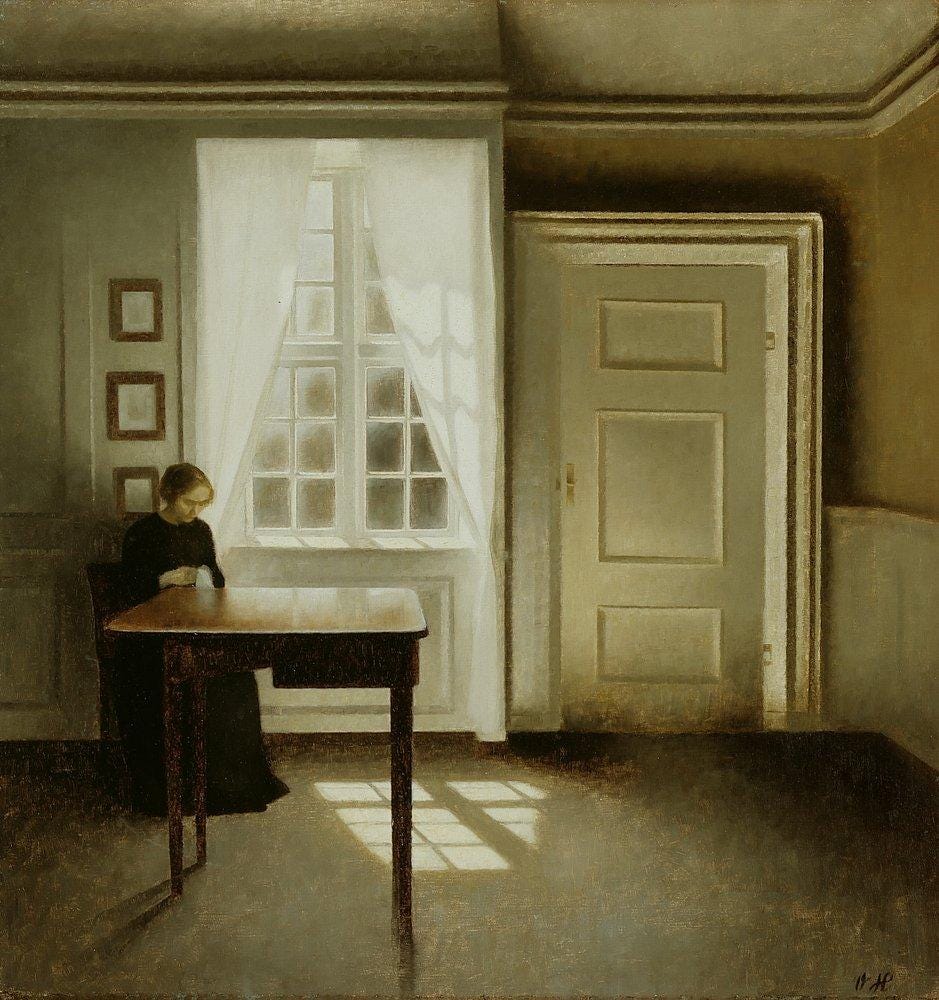
By evening the window has acquired a second room. Your chair is there, faintly, hanging in the air above the street. As the sky darkens the reflection sharpens and you find yourself placed among the roofs. You lift a hand and a pale hand rises through a distant building. For a moment you seem to have become one of the things you can see through.
Then someone switches on a light behind you and the room takes back the glass.
One evening it will do this without your help. The chair will appear in the window and whoever lives here will lower the blind, knowing nothing about the person who once stood in this exact spot and found the prospect of ceasing to exist almost offensively hard to understand.
Until now death belonged to the species. You belonged to the afternoon.
The thought arrives while there is still something ordinary to be done. You were going to fetch a glass of water. Your thirst carries on, indifferent to the discovery that the creature feeling it has an expiry it cannot read. You go to the kitchen with the thought and the tap makes its usual noise.
Any guide to death starts at a disadvantage: its author is still alive. We have the deaths of others to go on, and our own refusal to believe we will follow them.
I. Rooms with No Address
Somewhere inside your skull a demolished house still has its windows. You can walk into it without crossing the ground it stood on. Someone long dead is sitting in their usual place and turns toward you as if your arrival were a small interruption. Their cup is within reach. You know which floorboard will complain under your foot.
The builders took the walls down years ago. They could do nothing about the version you carried off, and you have gone on furnishing it, supplying light to a space that no longer exists.
You may be older now than the person sitting there. They are the age at which you lost them and you have continued without their permission, so that when you approach you bring a face they never saw. You would like to ask what they make of it. The conversation cannot quite begin. Memory has kept the tilt of their head; it cannot find out what they would say to the person you have become. You stay in the doorway wanting more from the room than the room has.
There is something almost indecent in the arrangement. The dead depend on a living body to remember the sound of their cough. They go with you into places they would never have liked, taking up a little of your attention while you wait for a bank transfer to clear.
Eventually you too will become hard to locate. Someone may remember you most clearly while cutting a piece of fruit, noticing that their hand has repeated a movement they watched you make. You will be there for a second, inseparable from the knife.
Such familiarity is poor preparation for extinction. Nothing about remembering tells you what it is to cease.
A voice reaches you from the next room, asking something unimportant. You have heard it so often that most days you attend only to the information, whether dinner is ready, what needs doing tomorrow. Tonight you take longer than usual to answer, listening to the part of the voice the question does not require.
II. A Mouthful of Stars
The body is a peculiar place to keep a person. It has to be fed even after you have lost interest in the world. It grows a fingernail while you grieve. Falling asleep after the worst day of your life, you leave it carrying on with tasks whose importance has outlived your ability to care about anything.
You have lived inside this activity so long you barely find it strange. Somewhere under the skin, breakfast is being dismantled. You are reading this sentence with the help of what you ate this morning. While you wondered whether your life had properly begun, your heart was beating through the hours in which you asked.
Much of the matter that composes you is older than the earth. Some of it was made in stars, long before there was a mouth to put fruit in. Now you bite into an apricot using calcium older than the ground you stand on. The juice runs over your thumb.
It is hard to hold the scale of this in mind. You have a body to wash and occasional reasons to dislike it. In photographs it refuses to resemble the person you expected. You ask it to hide its age and resent the evidence that it has kept you company all these years. There are days when your relationship with it is almost entirely complaint.
Yet this is the body someone once searched for in a crowd. They recognised you before you saw them, changing direction because your particular arrangement of matter had appeared at the far end of a platform. Whatever you believe about the soul, there are people whose relief has depended on seeing your face.
One day its work will stop. We like to imagine the last breath as the exhalation at the end of a long day, borrowing from sleep a gentleness we hope death will allow. Some deaths permit it. Others are painful, or come so early that everyone in the room is left protesting, and no account of mortality should grow so fond of its own language that it forgets the person struggling to breathe. Nor can you know which of your ideas will still be useful then. Having spent years on eternity, you may want someone to adjust your pillow. The need will be exact. It will belong to the body in that bed.
Until then there is this warmth under your clothes. Resting a palm against someone’s back, you can feel the slight movement of their breathing. You keep your hand there. They go on with whatever they were saying, unaware that you are listening differently now.
III. The Witness Who Will Not Leave
Imagine that you have disappeared. A room presents itself, empty, and you are there to observe the emptiness. You remove the room and replace it with darkness. Still someone is noticing the lack of light.
Even your image of nothingness contains a witness.
You try again. You let the darkness run past any possible boundary. Nothing moves. You have abolished the world with some thoroughness and somehow kept the person checking your work.
Sometimes the scene becomes a sea. You stand at its edge watching the last visible swell go into black water, and further out you picture the boundary of the self dissolving. The image pleases some exhausted part of you; briefly you feel you understand. Then the water makes a sound and you find you are still standing on the shore.
Perhaps awareness continues after death. Perhaps it ends with the body. You can inhabit either possibility in imagination and acquire feelings that resemble conviction. The trouble starts when you ask those feelings what will happen. Our words give us away: we speak of sleep, though a sleeper wakes; we speak of passing and find we have already imagined somewhere to arrive.
There are nights when the uncertainty is nearly unbearable. You want a definite shape to fear. Even a terrible country would have the advantage of geography.
Meanwhile much of the life you do know is spent under a different kind of scrutiny. An old humiliation returns while you are washing a cup, as vivid as if someone had just repeated it in front of you. You imagine that with enough time you could correct the impression and finally be understood. But the people whose verdict once seemed decisive have grown old. Some barely remember the occasion you are still trying to redeem. You have forgotten things that someone else may believe you will hold against them forever. There is relief in noticing how little of this is as permanent as it feels, and a question follows it. What would you do with the time it has been taking from you?
There is no need for a worthy answer straight away. You could finish washing the cup and go outside.
Under the stars you may feel the answer ought to be visible somewhere among them. Light has crossed distances you can scarcely conceive and arrived at your eyes while you stand there in clothes you should have replaced years ago. You are equipped to receive this light. You have no corresponding faculty for learning what becomes of the receiver.
For a while you stay out anyway. The humiliation has dropped out of mind. Somewhere in the house your unfinished work is waiting; it will matter again when you go back, though perhaps with less authority than before. You go in having learned nothing you could confidently report. The room feels different for a few minutes.
IV. Where the Dead Keep Their Hands
After someone dies their belongings can seem almost insolent. A shoe keeps the shape of a foot. A coat hangs with its sleeves empty, still proposing the arms it was made for. Touching the fabric you meet something that has been closer to the person than you can be again.
The world is full of these surviving surfaces. You find their handwriting on an envelope and the hand that made it seems suddenly recoverable. It was moving here. The ink proves that much.
For someone who loves you, the persistence of your atoms will be little help with such an envelope. They miss a person who could be asked to explain a word. The matter of the body will carry on in other arrangements, entering a world that will have no reason to call it by your name. Love has learned a face. It cannot be expected to take the universe in exchange.
Still, you may long for some enormous elsewhere in which the person is kept. Imagine an archive large enough to hold everything that was ever lost. You open a drawer and find an afternoon with its weather still attached. Your mother is younger than you are now. She is looking for something she has mislaid, and you know, with the unreasonable certainty of a dream, that you could help her find it. You would spend eternity on that errand if it let you stay in the room.
Then you close the drawer you invented. The wanting has given you a place to visit. It has given no evidence that anyone lives there.
What remains is stranger and smaller. Years after a death you hear yourself using a phrase you disliked in the person who used to say it. Their expression has outlasted your objections and settled into your speech while you were busy elsewhere, and someone who knew them looks up. Or you teach a child to do something with their hands and realise halfway through that you are repeating a lesson whose first teacher is gone. The child is watching you. They cannot see how many people are involved.
These continuities will become impossible to follow. Memories alter with repetition. The people who remember you will die, taking with them details nobody wrote down, and much of a life goes this way, without anyone knowing which recollection was the last. It is hard to accept how little can be kept.
There may be no one left to remember the evening you stayed beside a frightened person until they slept. But during that evening you were there. Their breathing settled. You waited before moving your hand, making sure they would not wake.
What happened does not have to keep happening in order to have happened.
V. The Unsupervised Afternoon
Knowing you will die can make you unpleasant company for yourself. An afternoon lies ahead and you begin to interrogate it. Have you used enough of your abilities? Should you be somewhere more memorable? The hours pass while you work out how to stop them passing without sufficient incident.
The demand to live fully can become one more way of refusing the life you have.
You cannot stay continuously astonished to be alive. Much of a life goes into maintenance. Someone has to buy the food. Collecting a child at the end of the day, you may be thinking mainly about the traffic, hardly noticing how easily they hand themselves over to your arrival. Years later they may remember that you were always there.
A life may be given to a handful of people. You learn their habits so thoroughly that you can tell something is wrong before they mention it. The attention this takes is easily overlooked, most of all by the person giving it, and years pass in which you believe you have done very little. Then someone recalls an occasion when you noticed they needed help. You barely remember it. For them it stayed.
There will also be hours that answer to nobody. Reading by an open window you look up and find the rain has stopped. Water is gathering at the tip of a leaf. The drop grows heavy enough to fall, and another begins. You watch for longer than you meant to.
Below the soil the tree extends into a darkness you have never seen. You know the branch outside your window intimately; you would recognise its shape in winter. The other half has been underground for the whole of your acquaintance, taking what it needs from the earth while you thought you knew what you were looking at. For a moment the whole world seems to have this concealed depth. Everything familiar continues past the part you can reach. The feeling can be almost physical, as though your ribs had briefly let your lungs have more room. Trying to describe it afterwards, you find you are talking about the weather.
Then the phone rings. Someone needs an answer you would rather not give, and you go back to being the person you were before the rain stopped, with a little of that extra room left over.
You will lose it again. The people you love will irritate you. Knowing they are mortal turns out to be surprisingly little help when they repeat a complaint you have heard twice already. Knowing that someone will die does not tell you how to live with them on a difficult Tuesday. You still have to learn that from the person.
You will have to listen to what they are saying. Now and then you will manage it, letting them finish without deciding in advance what they mean. An entire person has been living beside you, continuing beyond the part you know.
VI. On the Other Side of the Wall
The glass on the table catches the last light. For a moment its rim stays visible after the table itself has gone dark.
When death comes you may find that all your thinking has left you wanting another morning. Much will depend on circumstances you cannot rehearse. You have spent a lifetime becoming attached to the world, and some of the attachments are too deeply learned to be argued away. There are footsteps you recognise through a wall. Hearing them, you know who is home before the door opens. You learned this without deciding to, letting another person’s weight and pace become part of how you locate yourself.
Leaving may hurt in ways your largest thoughts have never approached. There is no prize for becoming prematurely indifferent to a world you love.
Whatever is unfinished will have to be left. Some ambitions may still trouble you. Others may seem to belong to a former occupant of your life, someone whose urgency you remember without quite sharing. For now you can still change your mind. The conversation you have postponed may still be possible, though beginning it means accepting that the other person has spent the intervening years becoming someone you have yet to meet.
Beyond the room the earth goes on turning, carrying the oceans through darkness. Somewhere a person is waking into a morning you will never enter. They lie still for a moment, hearing water move through the pipes. You do not know their name. Nothing in your life requires you to imagine them. Yet there they are, at the centre of an existence as hard to give up as your own.
A chair scrapes in the next room. The sound reaches you through the wall from a person whose life has happened close enough to yours for this particular noise to mean something.
You get up to see what they want, taking the whole bewildering body with you.